
High KSEB bills
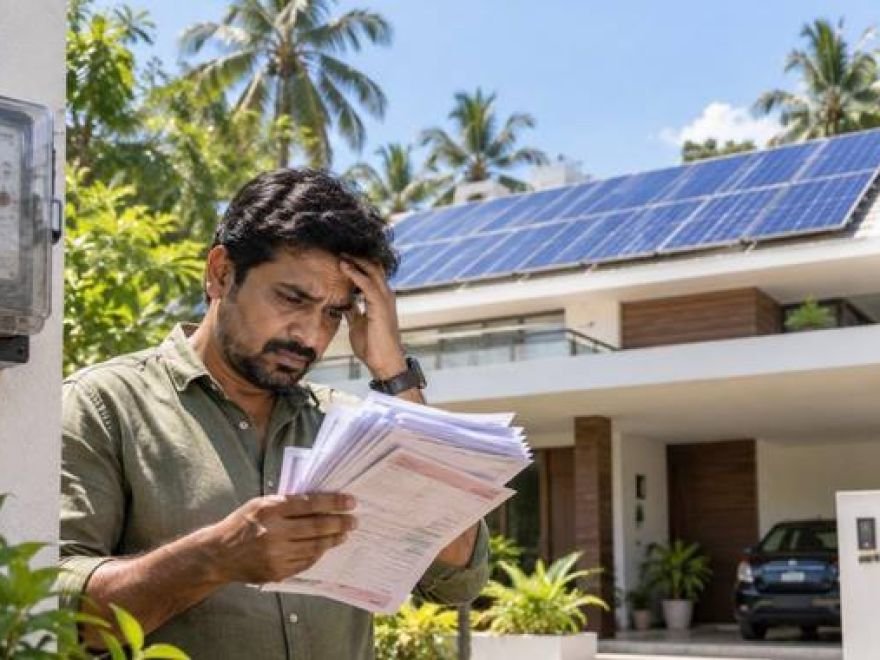
Cutting a high KSEB bill with rooftop solar
Kerala tariffs are slabbed, so the units at the top of a high bill are the expensive ones, and those are the units solar removes first.
Free site survey · written proposal in 24 hours
- Slabbed tariffs
- Twelve months of bills
- Load shifting
Will it help
Will solar reduce a high KSEB bill?
Yes, and the higher your bill the better the arithmetic works, because KSEB tariffs are slabbed. The units you remove come off the most expensive slab first. A household billing ₹2,300 to ₹2,900 a month is typically a 3 kW case; ₹3,800 to ₹4,800 is typically 5 kW. A survey reads twelve months of bills to establish which.
This is why the same system size produces very different savings for two households. What matters is which slab your last units sit in, not just how many units you use.
Bring twelve months of bills, not one.
Why slabs matter
The top of the bill is the expensive part
Solar removes units from the top of your consumption, which is where the rate is highest.
✓ Kerala tariffs step up as consumption rises
✓ Solar removes units from the top slab first
✓ The saving per unit is therefore higher on a high bill
Check the cause first
Not every high bill is a solar problem
Sometimes an old pump, a failing fridge or a geyser on a timer is the real culprit, and it is cheaper to fix that than to size panels around it.
✓ A failing geyser or pump can look like a tariff problem
✓ A faulty meter shows up in the twelve-month pattern
✓ We would rather find that than sell you an oversized system
WORK IT OUT
Put in one KSEB bill.
One question, one answer: how many kilowatts of solar does your home actually need?
✓ System size matched to your actual consumption
✓ Your exact PM Surya Ghar subsidy entitlement
✓ Expected monthly generation and roof area needed
₹10,500
Based on 1,400 units per kW per year at KSEB’s upper slab rates of ₹6.75–8.00 a unit. A 3 kW system generates about 4,200 units and saves roughly ₹31,500 a year.
*Generally an amount you receive for your residential or commercial bill.
Printed on your bill. It differs between slabs.
We need a name and a number to send your result and to call you back about a free survey.
What we look at
Reading the bill properly
Twelve months of bills, not one
Consumption swings with the seasons in Kerala. A single bill is a misleading basis for sizing.
Load shifting increases the benefit
Running flexible loads in daylight uses generation directly rather than exporting it.
Trusted brands. Krafted for you.












Questions
High bills, answered
It depends on your consumption, your usable roof and how much of your load falls in daylight hours. Because KSEB tariffs are slabbed, removing units from a high bill saves more per unit than from a low one. A survey reads twelve months of bills before anyone should quote you a figure.
Yes, and it lines up well. The strongest generation months in Kerala are February to April, which is when air-conditioning load peaks.
Look at both. If something specific is driving the bill - an ageing pump, a failing appliance - fixing it is usually cheaper than adding capacity to feed it. We will say so if we see it at survey.
Next step
Send us twelve months of bills.
We will tell you what is driving the bill before we talk about panels.
Explore
Related pages
Explore