
Rooftop solar · Kerala
Rooftop solar for homes and businesses in Kochi & Ernakulam
About 1,400 units per kilowatt per year on a well-oriented Kerala roof. Whether yours is one of them is a question of shade and area.
Free site survey · written proposal in 24 hours
- Homes & businesses
- Net metered
- Subsidy handled
Is it worth it
Is rooftop solar worth it in Kerala?
For most Kerala roofs with reasonable shade-free area, yes. A well-oriented roof generates about 1,400 units per kilowatt per year here: roughly 3.9 units per kilowatt per day averaged across the year. With the PM Surya Ghar subsidy on residential systems and KSEB net metering banking your surplus, the arithmetic works for most households whose bill sits in the upper KSEB slabs.
The two things that decide whether it works on your roof are usable shade-free area and your actual consumption. Neither can be judged from a phone call, which is why the survey comes first.
Neither can be judged from a phone call.
Generation
What a Kerala roof actually produces
Kerala averages roughly 3.9 units per kilowatt per day across the year. February to April are strongest; June to August, during the south-west monsoon, are weakest.
✓ Roughly 3.9 units per kW per day, averaged over the year
✓ Strong months bank credit that carries the monsoon
✓ Orientation and tilt change the figure, shade changes it most
Roof area
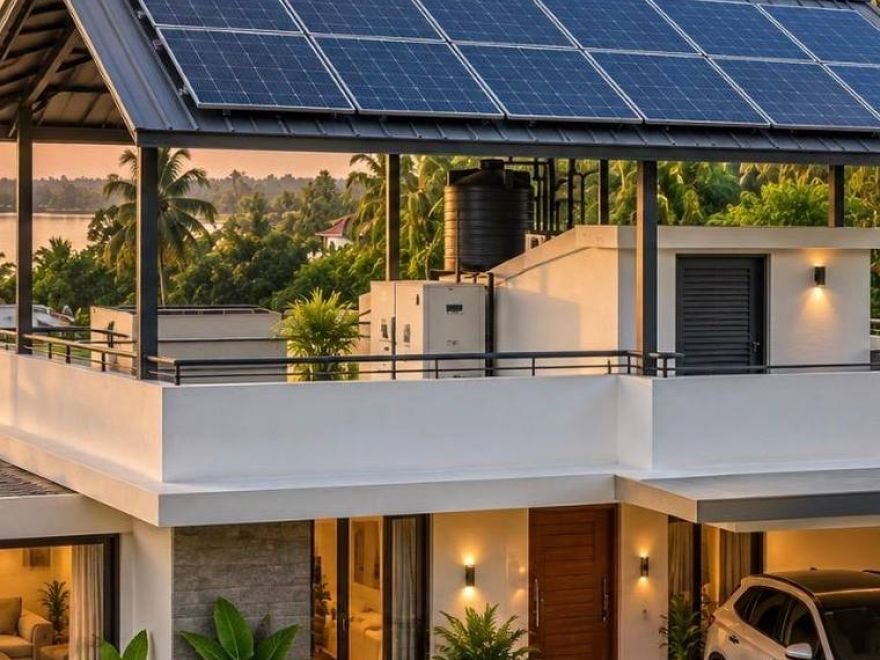
How much clear roof a system needs
A 3 kW system needs roughly 210 to 270 sq ft that stays clear of shade between about 9 am and 4 pm.
✓ 70 to 90 sq ft of shade-free roof per kilowatt
✓ Water tanks, parapets and palms all reduce usable area
✓ Measured on site, not estimated from a satellite image
What we provide
Solar solutions, end to end
Every system is designed around your own roof and your own electricity use, for homes and for businesses. Tell us which of these fits and we will survey the site free of charge.
Residential Solar
For homes
✓ Rooftop solar for homes
✓ System design based on your electricity usage and roof conditions
✓ KSEB and net-metering guidance
✓ Subsidy assistance where applicable
✓ Installation and commissioning
✓ Ongoing support
Commercial Solar
For businesses
✓ Rooftop solar for businesses
✓ System design based on your load and roof conditions
✓ Energy-use assessment
✓ Installation and commissioning
✓ KSEB and grid coordination
✓ Ongoing support
Solar System Options
Choose the configuration that fits the site
On the roof
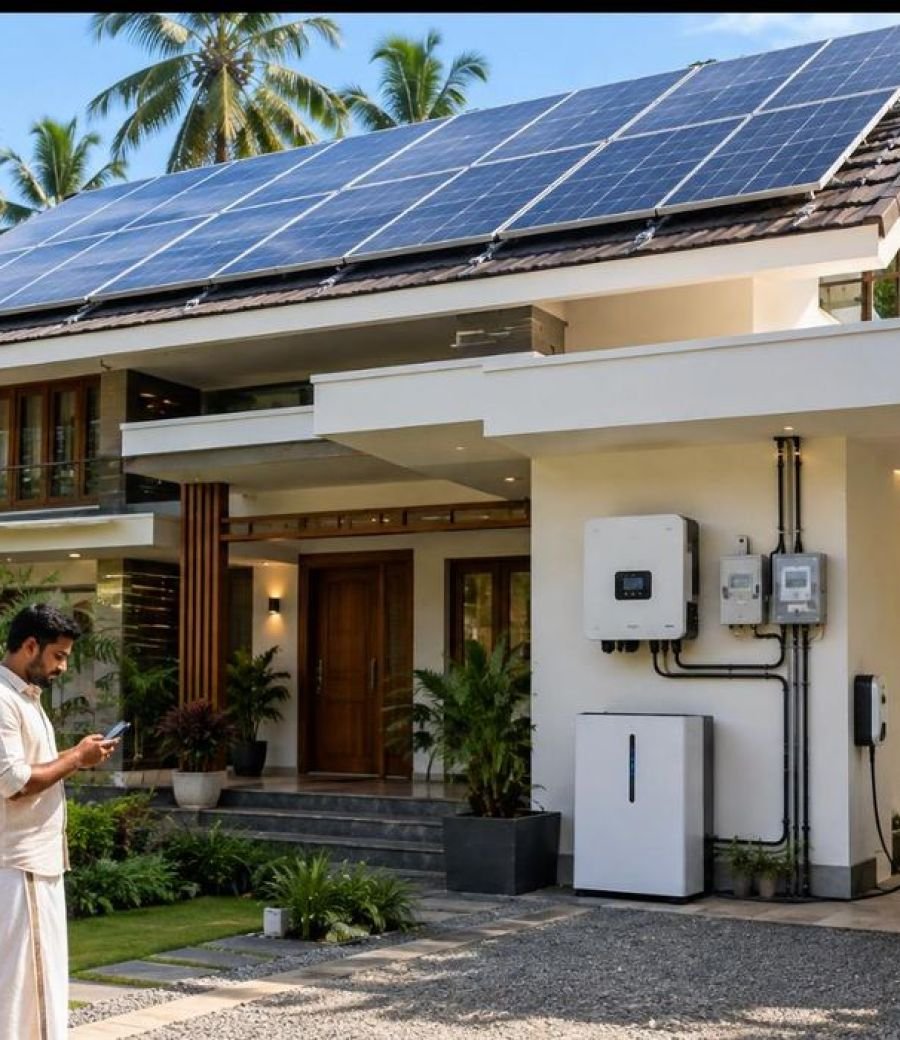
What a finished installation looks like


What decides it
The two real constraints
Net metering carries the monsoon
Credit banked in the strong months offsets the wet months, which is why the annual figure matters more than any single month.
Shading is the usual constraint
Coconut palms, water tanks, parapets and neighbouring buildings, not the amount of sunshine.
Trusted brands. Krafted for you.












Questions
Rooftop solar, answered
About 1,400 units per kilowatt per year on a well-oriented, unshaded Kerala roof. A 3 kW system generates roughly 4,200 units a year, or about 350 units a month as an annual average.
Roughly 70 to 90 sq ft of shade-free roof per kilowatt.
It produces less, not nothing. June to August are the weakest months. The annual figure of about 1,400 units per kilowatt already accounts for them, and net metering banks surplus from the strong months against them.
Under PM Surya Ghar: ₹30,000 per kW for the first 2 kW, ₹18,000 for the third kW, with a ceiling of ₹78,000 for systems of 3 kW and above. Commercial connections are not eligible.
Next step
Find out what your roof can do.
One visit, one honest answer. If it is not suitable, we say so.
Explore
Related pages
Explore